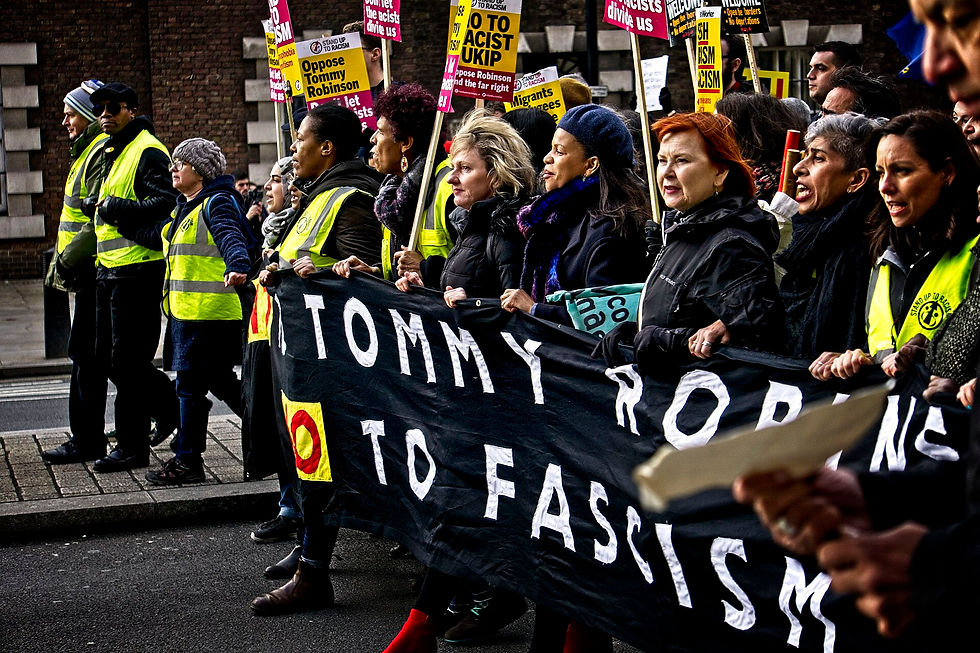
.jpg)
Tommy Robinson: The “People’s” Poison
How Grievance Merchants Sell the Far Right Back to the People It Harms
By Phen Weston
Founder's Note
This essay is a political and cultural critique of Stephen Yaxley-Lennon, better known as Tommy Robinson, and of the wider machinery of far-right grievance politics.
It is concerned not only with one public figure, but with the way real social pain can be redirected away from power and toward migrants, Muslims, refugees, and vulnerable communities. The essay draws on court records, journalism, and academic sources to distinguish between public mythology, legal record, and political performance.
It is published as part of the Darkness Warmth Press Journal because the press is not only interested in stories, but in the forces that shape them: fear, myth, belonging, cruelty, responsibility, and the human cost of the narratives we choose to believe.
Abstract
This essay examines the public mythology surrounding Stephen Yaxley-Lennon, better known as Tommy Robinson, and the wider machinery of far-right grievance politics. It argues that the Robinson persona depends on a repeated transformation of accountability into persecution, legal consequence into martyrdom, and social anxiety into suspicion of vulnerable communities.
Drawing on court records, journalism, and academic research, the essay distinguishes between the cultivated image of the “persecuted patriot” and the documented record beneath it. It pays particular attention to the Jamal Hijazi libel and contempt proceedings, using that case as a way of cutting through the theatre of martyrdom and returning attention to the human cost of falsehood, scapegoating, and political performance.
More broadly, the essay considers how real social pain — poverty, alienation, failing services, political abandonment, and collapsing trust — can be redirected away from power and toward migrants, Muslims, refugees, and other marginalised groups. It argues that figures such as Robinson do not heal these wounds, but keep them open, selling fear back to the people already harmed by decline.
At its heart, this is an essay about poison dressed as protection: how grievance becomes a brand, how prejudice is laundered as patriotism, and how wounded communities are taught to mistake scapegoating for truth.
First, the mask
Tommy Robinson has spent years selling a very particular image of himself: the persecuted patriot, the blunt man in the crowd, the one brave enough to say what everyone else is supposedly too frightened to say.
It is a useful costume. Simple. Loud. Marketable.
But “Tommy Robinson” is not merely a name. It is a product. His legal name is Stephen Yaxley-Lennon, and he has used the Robinson pseudonym for political purposes (Courts and Tribunals Judiciary, 2018). His public career is also tied to the English Defence League, the far-right organisation he founded or co-founded in 2009 (BBC News, 2013; Associated Press, 2024).
That matters. Not because a name alone proves anything. People rename themselves all the time. But in his case, the name has become a machine for charging the emotional meaning of events. Consequence becomes persecution. Notoriety becomes influence. Legal defeat becomes martyrdom. Falsehood becomes “truth” if the right audience already wants it to be true.
That is the first trick of the grievance merchant: to make accountability look like oppression.
His supporters are encouraged to see him not as a political agitator with a long public history of controversy, criminal convictions and adverse court findings, but as a lone man standing bravely against a corrupt establishment. That is the mythology. The record is colder, uglier and harder to romanticise (ITV News, 2018; Reuters, 2024a).
In 2021, Syrian refugee Jamal Hijazi successfully sued Yaxley-Lennon for libel after false allegations were made against him. In 2024, Yaxley-Lennon was jailed for contempt of court after admitting he breached an injunction preventing him from repeating those allegations (Hijazi v Yaxley-Lennon, 2021; Reuters, 2024a; Reuters, 2024b; HM Solicitor General v Yaxley-Lennon, 2024). I will keep coming back to the Jamal Hijazi case because it cuts through much of the theatre.
This distinction is not pedantry. He was not imprisoned for “telling the truth”. He was imprisoned after admitting contempt of court for claims already tested and found wanting in law (Reuters, 2024a).
And yet that is exactly where the mask does its work. The legal process vanishes. The victim vanishes. The false claims vanish. What remains is simplified theatre: Tommy against the system. Tommy against the elites. Tommy against the enemies of Britain.
This essay is not a defence of censorship. It is not an argument that Britain has no real problems. It does. Poverty, alienation, collapsing trust, failing services, unaffordable housing and political abandonment are not imaginary wounds. They are real. But men like Robinson do not heal them. They press on them. They keep them open. They name the wrong enemy, then sell the infection as medicine.
So the mask has to come off.
Then the machinery underneath
Robinson did not emerge from nowhere, no matter how carefully the mythology tries to pretend otherwise. The story sold to supporters is neat: an ordinary working-class patriot “spoke up” and was punished for it. The historical record tells a messier story, rooted in organised street politics, anti-Muslim agitation and the deliberate construction of a populist far-right identity.
Before the livestreams, legal dramas, crowdfunding campaigns and martyrdom loops, there was the English Defence League.
The EDL, founded in 2009, presented itself as a movement against Islamic extremism. That framing mattered. It gave the organisation a cleaner public image. It allowed it to say the target was narrow, even as its demonstrations and rhetoric repeatedly bled into broader hostility toward Islam and Muslims. The EDL became known not as a sober civic movement, but as a confrontational street organisation associated with far-right politics, anti-Muslim sentiment, public disorder and aggressive demonstrations (BBC News, 2013; Morrow and Meadowcroft, 2019; Reuters, 2024b; Associated Press, 2024).
This is where the “ordinary bloke” performance starts to crack. Robinson was not simply a bystander who noticed social tension and said something unfashionable. He was part of a machinery that helped turn fear into spectacle. Research on the EDL emphasises its anti-Islamic street-protest identity, its collective-action dynamics and the “participatory crowding” that helped mobilise supporters before contributing to its decline (Morrow and Meadowcroft, 2019).
That machinery took real anxieties - about extremism, grooming gangs, social fragmentation, state failure, political silence - and fed them through flags, chants, marches, confrontation and grievance. It did not offer repair. It offered enemies.
That is the bit people often miss. Movements like this do not need every participant to begin in hatred. Some are angry. Some are frightened. Some feel ignored. Some sincerely believe they are defending their communities. Academic work on the EDL suggests a looser, more unstable movement than a disciplined party structure, with participation shaped by identity, solidarity, self-worth, and collective mobilisation as much as by ideology (Morrow and Meadowcroft, 2019).
But that does not make the direction harmless. A crowd does not need unanimous hatred to become useful to the far right. It only needs enough people to accept where their anger is being pointed.
And Robinson’s great utility has always been his ability to point.
Not upward. Not toward wealth, exploitation, austerity, corruption, cynical politicians, landlords, donors, press barons, corporate interests or the political class that has hollowed out public life. Sideways. Downward. Toward migrants, Muslims, refugees and communities already made vulnerable by suspicion.
This is the machinery: take pain, give it a costume, name the wrong enemy, then call the result patriotism.
Later, when Robinson distanced himself from the EDL, the brand had already done its work. His public career had also become linked to other movements and platforms, including Pegida UK, Rebel Media, and his advisory role with UKIP under Gerard Batten (Allchorn, 2016; Johnston, 2018; The Guardian, 2018; The Parliament Magazine, 2018). These associations matter because they show a repeated pattern: rebranding extremism as concern, agitation as free speech, and prejudice as patriotism.
The street movement did not disappear. It adapted. It moved online. The chant became a livestream. The march became a media operation. The mask learned to broadcast itself (BBC News, 2013; Allchorn, 2016; Mulhall, 2019).
Not a martyr. A record.
The mythology asks for faith. The record asks for memory.
This is where the Robinson persona becomes most useful to Stephen Yaxley-Lennon. A persona can be polished. It can be wrapped in a flag, shoved in front of a camera and made to look persecuted. A record is more stubborn. A record has dates. Judgments. Convictions. Findings. Damages. Sentences. Names of victims. Names of courts.
And his public record does not resemble the clean biography of a silenced patriot. It resembles something much more ordinary and much grubbier: criminality, legal defiance, public disorder, fraud, contempt and the repeated conversion of consequence into content.
Reported convictions and legal findings attached to Yaxley-Lennon include assault, public order offences, mortgage fraud, use of another person’s passport to enter the United States, contempt of court and libel-related contempt proceedings (ITV News, 2018; Reuters, 2024a; Reuters, 2024b; Associated Press, 2025). These are not loose decorative details around the story. They are central to the gap between the brand and the man.
The passport offence alone punctures much of the theatre. In 2013, Yaxley-Lennon was jailed after admitting that he used someone else’s passport to travel to the United States. A man who would later build so much of his politics around borders, identity, threat and national belonging had already treated the border as negotiable when it suited him (ITV News, 2018).
Then there is the mortgage fraud. In 2014, he was jailed for fraud connected to a mortgage application. The point is not that a person who commits a crime can never change. Of course people can change. The point is that his pose depends on moral clarity: corrupt elites over there, honest patriots over here. Fraud dirties that clean division (ITV News, 2018).
But the Jamal Hijazi case remains the clearest window into the harm. In 2021, Hijazi successfully sued Yaxley-Lennon for libel after false claims were made about him. The court awarded Hijazi £100,000 in damages. In 2024, Yaxley-Lennon was jailed for contempt of court after admitting that he had breached an injunction preventing him from repeating those allegations (Hijazi v Yaxley-Lennon, 2021; Reuters, 2024a; Reuters, 2024b; HM Solicitor General v Yaxley-Lennon, 2024; Associated Press, 2024).
This is not a technicality. It is the whole point.
In the Robinson mythology, the system crushes a man for speaking plainly. In the court record, a refugee schoolboy was falsely accused, won a libel case, obtained an injunction, and then watched the man who had defamed him continue to circulate the same poison (Hijazi v Yaxley-Lennon, 2021; Reuters, 2024a; HM Solicitor General v Yaxley-Lennon, 2024). The victim is then erased so that Robinson can remain the hero of his own persecution story.
That erasure disgusts me, frankly. The public is invited to stare at the prison sentence, the outrage, the supporters outside court, the camera flashes and the fundraising. It is not invited to dwell on Jamal Hijazi. It is not invited to think about what happens when a child refugee is made into a target by a grown man with an audience. It is not invited to ask who pays the human cost when conspiracy becomes content.
So look at the filings, not the flag. Look at the judgment, not the chant. Look at what the courts actually found, not what the brand says the courts fear.
Once you do that, the martyr disappears.
Here is the grift, as plainly as I can put it
For a normal public figure, this record would be fatal. For Robinson, it becomes raw material.
That is the central trick of the grift. Nothing is allowed to remain what it is. A conviction becomes persecution. A court order becomes censorship. A journalist becomes an enemy. A refugee child becomes a symbol. A legal consequence becomes a fundraising opportunity. Reality is not exactly denied; it is processed, repackaged and sold back to the faithful in a more useful form.
The grift works because it does not ask supporters to examine the facts. It asks them to feel the story.
And the story is always the same: Tommy is under attack.
That is why the Hijazi case matters so much. In legal terms, the matter is clear enough. Yaxley-Lennon lost a libel case after making false claims about Hijazi, was made subject to an injunction, and later jailed for contempt after admitting he breached it (Hijazi v Yaxley-Lennon, 2021; Reuters, 2024a; Reuters, 2024b; Associated Press, 2024; HM Solicitor General v Yaxley-Lennon, 2024). But inside the mythology sold to supporters, the detail dissolves. The court record becomes foggy. A child disappears. A lie becomes a cause.
That is not politics. It is theatre with a payment link.
The grift depends on a permanent crisis. The audience has to be kept emotionally mobilised: angry enough to donate, frightened enough to share, loyal enough to overlook contradiction. This fits a wider pattern in populist radical-right mobilisation, where grievance, crisis narratives and “the people” versus “the elite” framing help sustain political identity (Mudde, 2007; Rydgren, 2007; Muis and Immerzeel, 2017).
Facts alone often fail against this kind of politics because the facts are not simply disputed. They are absorbed. A libel defeat does not puncture the myth if the audience has already been taught that courts are corrupt. A contempt finding does not matter if supporters have already been trained to hear “injunction” as “silencing”. A criminal record does not disqualify the martyr if the martyr has made criminality look like sacrifice.
There is a grim cleverness in it. The worse the record becomes, the more useful the persecution narrative becomes. The more institutions condemn him, the more he can claim they fear him. The more journalists investigate him, the more he can cast journalism itself as part of the plot.
But this is not rebellion. It is branding.
Robinson’s politics has repeatedly relied on the aesthetic of courage without the discipline of responsibility. He presents himself as a man prepared to face consequences, but the consequences are always narrated as someone else’s wrongdoing. The courts are wrong. The media is wrong. The establishment is wrong. The victim is forgotten. The follower is flattered. The leader remains pure.
That purity is essential. The audience must not be asked to see a man with convictions, failed legal arguments, false allegations and a history of far-right agitation. They must be invited to see themselves under attack through him. If Tommy is punished, they are punished. If Tommy is criticised, they are silenced. If Tommy is jailed, Britain itself is supposedly in chains.
This is how a personal brand becomes a political addiction.
And yes, there is a literal financial ecosystem around it. Robinson has repeatedly positioned himself as persecuted and abandoned while operating within a grievance economy built on donations, subscriptions, legal fundraising, speaking appearances, merchandise and constant outrage. Reports surrounding his finances have included bankruptcy, gambling losses, tax issues and debts reportedly reaching into the millions (Halliday, 2022; Nelsons, 2022; Pogrund, 2024).
The irony is not subtle. A man claiming to speak for the abandoned working public increasingly appears sustained by an industry of permanent anger, where outrage itself becomes a product, a platform, and an income stream.
That may be the most poisonous part. The wounds are real. The abandonment is real. The despair is real. Robinson does not invent the pain. He just points it away from power, teaches it to punch downward, and calls that cure.
Borders, but only for other people
The hypocrisy is not that Robinson has reportedly lived abroad or used Spain as a place of retreat. There is nothing inherently wrong with leaving one country for another, seeking comfort elsewhere or building a life beyond the place of one’s birth. Millions of people do exactly that, for work, family, safety, climate, cost, opportunity or preference (Boffey, 2025).
The hypocrisy lies somewhere else. It lies in building a public career of suspicion toward outsiders while treating borders as flexible when they serve your own convenience. It lies in selling national siege while enjoying the privileges of movement, distance and escape. It lies in performing as the defender of Britain while seeming perfectly willing to conduct that defence from somewhere sunnier, safer and more comfortable when the pressure rises.
That is performative nationalism in miniature. The nation is sacred when it provides a stage. The flag is sacred when worn as a costume. The border is sacred when it can be used against someone else. But when personal comfort enters the equation, the hard lines soften.
Robinson is not alone in this. Modern populist politics has produced a recurring type: the self-styled champion of ordinary people who somehow lives at a comfortable distance from the consequences of the anger he cultivates. These men speak the language of sacrifice, yet are rarely asked to sacrifice anything. They rage against elites while becoming media personalities, political brands, donation machines and celebrities of grievance.
Nigel Farage belongs in the wider note here, not because he and Robinson are identical, but because the performance is familiar. The man-of-the-people pose. The anti-establishment theatre. The careful cultivation of resentment. The transformation of national decline into a personal platform. Farage offers the pint-glass version. Robinson offers the street-corner version. Different registers, different levels of respectability, but both feed from the same trough of grievance: the claim that Britain’s pain can be explained through outsiders, traitors, elites and enemies within.
This is why the Spain point matters only if handled carefully. It should not become an argument against migration. That would immediately surrender the moral ground. It should be used against selective humanity: against the politics that treats movement as legitimate when “we” do it and threatening when “they” do it; against men who turn other people’s journeys into invasion narratives while treating their own as lifestyle choices (Boffey, 2025).
The contradiction also appears in his reported travel to Muslim-majority countries. If Islam itself is the civilisational threat, why is its presence tolerable when the setting is useful, comfortable, profitable or politically convenient? Robinson’s issue is not really with “Islam” as an abstract danger. It is with Muslims as a domestic political target. Abroad, Muslim-majority societies can become destinations, backdrops or propaganda stages. At home, Muslim communities become the enemy required to keep the brand alive (Searchlight, 2025).
The phrase “people’s champion” begins to sour under that light. What kind of champion teaches the public to fear the vulnerable while reserving the softest explanations for himself? What kind of patriot makes a living from national emergency while keeping one eye on the exit?
His nationalism has the quality of a costume: loud, cheap, and quickly adjusted when consequences enter the room.
And I do mean small-man politics here, though not in height. In spirit. In the constant inflation of grievance into heroism. In the need to turn every criticism into persecution, every setback into martyrdom, every contradiction into someone else’s conspiracy. Chest-beating without service. Flag-waving without responsibility. Patriotism without humility.
Real patriotism requires more than shouting a country's name into a camera. It requires care for the people who live there, including those who do not look like you, pray like you, vote like you or arrive by a route you approve of. Robinson’s version offers something easier: a homeland with no compassion, a flag with no duty attached, a politics of belonging built on deciding who must never belong.
Who actually pays
The danger of Robinson’s politics is not only that it is ugly. Ugly politics can sometimes be mocked, resisted, laughed out of serious rooms. The greater danger is that it teaches people to misread their own suffering.
That is how the poison spreads.
A person feels abandoned by politics. Their town has been hollowed out. Their wages have stagnated. Their rent climbs. The GP appointment is added to a waiting list. Their children cannot afford homes. The high street looks tired, underfunded, unloved. Their trust in institutions collapses.
Then along comes the grievance merchant with a beautifully simple answer.
It was them.
Migrants. Muslims. Refugees. Outsiders. The people who came here. The people who do not belong. The people supposedly taking what should have been yours.
History has heard this music before. The targets change, but the mechanism remains familiar: take a wounded public, name an outsider and teach people that their suffering has a human face. In other eras, the targets have included Jews, Catholics, Roma communities, Black communities, refugees, trade unionists, intellectuals, “foreigners” and “cosmopolitans”. The names shift to suit the moment. The trick does not (Channing, 2018; Rydgren, 2007; Mudde, 2007).
Social pain is redirected away from power and toward human targets. Complexity is reduced to contamination. Cruelty begins to feel like defence. Fear begins to feel patriotic. Scholarship on the radical right repeatedly identifies nativism, authoritarianism, populism, crisis narratives and scapegoating as central ingredients in this style of mobilisation (Mudde, 2007; Rydgren, 2007; Muis and Immerzeel, 2017).
This is not history repeating itself perfectly. It is history repeating its instincts.
The political class escapes. The wealthy escape. The press barons escape. The landlords, donors, corporations, austerity architects and opportunists escape. Power remains largely untouched, while public anger is turned sideways and downward onto communities with less power, less protection and less room to breathe.
That is the real function of Robinson’s politics. It does not challenge power in any meaningful way. It protects power by giving wounded people someone weaker to blame, a pattern consistent with historical and contemporary far-right scapegoating (Channing, 2018; Rydgren, 2007).
And the damage is not theoretical.
When Muslims are spoken of as a threat, Muslim communities must live with the consequences. When refugees are turned into symbols, refugees must live with the consequences. When a child like Jamal Hijazi is falsely accused and dragged through years of public hostility, he must live with the consequences (Hijazi v Yaxley-Lennon, 2021; The Guardian, 2021; Reuters, 2024a). The man with the platform can move on to the next outrage. The target does not get to move on so easily.
That is why the “free speech” defence often rings so hollow. Speech is not harmless simply because it is loud. A lie with an audience can become a weapon. A rumour can become a threat. A slogan can become permission. A livestream can become a mob in waiting.
Robinson’s defenders may insist that he is only “asking questions” or “saying what people think”. But the questions are not innocent when they are designed to inflame. The thoughts are not neutral when they are cultivated, repeated, monetised and aimed. There is a difference between scrutiny and scapegoating. There is a difference between anger at injustice and the deliberate manufacture of suspicion.
The cruellest part is that the people drawn into this politics are also being used. They are told they are awake, when they are being managed. They are told they are brave, when they are being pointed. Their pain is real, but the cure offered to them is rotten.
A movement like this cannot afford to solve anything. It needs the wound open. It needs the anger fresh. It needs the enemy present. If the public ever stopped to ask why their lives were harder, who profited from decline, who sold off the future and who underfunded the systems they depend on, the spell might break. The permanence of grievance is a recurring feature of populist radical-right politics, not an accidental by-product (Mudde, 2007; Muis and Immerzeel, 2017).
So the spell is renewed. Another migrant. Another Muslim. Another court case. Another betrayal. Another video. Another emergency. Another demand for loyalty.
This is the damage Robinson does: he narrows the moral imagination. He teaches people to see neighbours as invaders, children as threats, difference as danger and cruelty as courage. He makes Britain smaller, meaner and more frightened, then calls that fear patriotism.
How poison gets cleaned up
Extremism rarely announces itself honestly. It learns to change clothes.
It calls itself “concern”. It calls itself “free speech”. It calls itself “patriotism”. It claims it is only asking questions, only defending women, only protecting children, only saying what ordinary people already think. The vocabulary softens. The target remains. This kind of respectability laundering is evident in the way contemporary British far-right actors attempt to modernise, mainstream, and reframe older forms of prejudice as civic concerns (Allchorn, 2016; Mulhall, 2019).
That is how the politics becomes respectable enough to circulate. Hate is not always sold as hate. More often, it is sold as vigilance. Suspicion becomes common sense. Cruelty becomes honesty. Bigotry becomes bravery. A movement that once marched in the street learns the language of podcasts, documentaries, rallies, donor platforms and “citizen journalism” (Mulhall, 2019).
Robinson’s role in this ecosystem is not subtle. He takes the raw material of far-right agitation and presents it as public service. He does not need to persuade his audience that they are hateful. He only needs to persuade them that their fear is rational, their anger is moral, and their scapegoats deserve it.
This laundering also lets supporters deny what they are supporting. They do not have to say they hate Muslims. They can say they oppose extremism. They do not have to say they resent migrants. They can say they care about borders. They do not have to say they enjoy cruelty. They can say they are tired of political correctness. Each phrase creates distance between the respectable surface and the uglier impulse beneath it (Allchorn, 2016; Mudde, 2007; Rydgren, 2007).
That distance is where the poison works.
Once the language has been cleaned, the politics travels further. It enters comment sections, pub conversations, family group chats, newspaper columns, livestreams and campaign speeches. It no longer looks like street extremism. It looks like “common sense”. It looks like “concern”. It looks like “just saying”.
But a cleaned-up lie is still a lie. A polished prejudice is still prejudice. And a politics built around fear of the outsider does not become harmless simply because it has learned better lighting.
That is how poison enters the bloodstream: not as poison, but as medicine.
The wound is real. That is the trap.
This is the part that matters most to me, because it is where easy contempt fails.
People are angry for real reasons. Britain is full of towns that feel abandoned, workers who feel disposable, families priced out of stability, public services stripped thin, and communities left to decay while politicians speak in slogans and donors dine well. The point is not that these conditions are unreal. The point is that populist radical-right politics converts social and economic grievance into exclusionary identity politics rather than material repair (Muis and Immerzeel, 2017; Rydgren, 2007).
That pain deserves seriousness. It deserves policy. It deserves solidarity. It deserves repair.
Robinson offers none of that.
He offers emotional direction, not liberation. He tells people where to point their fear. He gives them enemies close enough to hate, but rarely powerful enough to blame. He makes the wounded feel brave while keeping them wounded. He flatters them as truth-tellers while feeding them a politics that leaves the actual machinery of decline untouched.
This is why sneering at his followers is not enough. Many are not powerful. Many are frightened. Many have been failed. But being failed does not make cruelty noble. Being angry does not make scapegoating true. Pain explains susceptibility; it does not excuse the poison.
The task is not to mock the wounded for being wounded.
The task is to stop men like Robinson from selling them infection as a cure.
What we are left with
So what remains when the mask comes off?
Not a martyr. Not a prophet. Not the last honest man in Britain. Not the brave voice of the forgotten.
What remains is Stephen Yaxley-Lennon: a man whose public career has been built through far-right agitation, criminal conviction, legal defiance, racialised suspicion, anti-Muslim politics, personal branding and the relentless conversion of consequence into martyrdom (ITV News, 2018; Morrow and Meadowcroft, 2019; Reuters, 2024a; Associated Press, 2024).
Robinson does not speak for the people. He speaks through them. He takes real anger and teaches it to serve false causes. He takes real abandonment and turns it into suspicion of the vulnerable. He takes real national decline and sells it back as a story of outsiders, traitors and enemies within.
He does not heal Britain’s wounds. He keeps them open.
He needs the fear. He needs the enemy. He needs the court case, the ban, the outrage, the march, the camera, the chant, the donation, the next betrayal. Without crisis, the performance suffocates. Without enemies, the brand starves.
That is why the poison must always be renewed.
Another migrant. Another Muslim. Another refugee. Another judge. Another journalist. Another conspiracy. Another reason for the faithful to stay angry, stay frightened, stay loyal.
And all the while, the real machinery of decline keeps turning elsewhere. The landlords still collect. The donors still dine. The politicians still posture. The public services still fail. The wages still stagnate. The rich still leave the bill on someone else’s table.
But Robinson’s audience is not asked to look there.
They are asked to look sideways. Downward. At the neighbour. At the mosque. At the refugee. At the child with the wrong name, the wrong skin, the wrong prayer, the wrong story.
That is the final obscenity of the performance: the man who claims to defend the wounded has learned how to feed on the wound. Their fear becomes his platform. Their rage becomes his relevance. Their despair becomes his market.
He is not the cure for Britain’s sickness.
He is one of the symptoms that learned how to sell itself as medicine.
And when the shouting fades, when the livestream ends, when the flag is folded, and the crowd goes home, what remains is not courage, not truth, not patriotism. Only the oldest trick in politics: a frightened people taught to mistake poison for protection, and a small, self-mythologising man made larger by standing on the wounds of others.
References
Allchorn, W. (2016) 'Cut from the same cloth?: Pegida UK looks like a sanitised version of the EDL', LSE British Politics and Policy, 15 January. Available at: https://blogs.lse.ac.uk/politicsandpolicy/pegida-uk-relaunched/ (Accessed: 28 May 2026).
Associated Press (2024) 'Founder of far-right English Defense League gets 18 months in prison for court contempt', AP News, 28 October. Available at: https://apnews.com/article/tommy-robinson-contempt-of-court-english-defense-league-2234f6eef821543feb688441c019384f (Accessed: 28 May 2026).
Associated Press (2025) 'English Defense League founder Tommy Robinson due for early release after UK judge’s decision', AP News, 20 May. Available at: https://apnews.com/article/tommy-robinson-early-release-prison-uk-f08f02d07601d9872054cfe30d20514f (Accessed: 28 May 2026).
BBC News (2013) 'EDL leader Tommy Robinson quits group', BBC News, 8 October. Available at: https://www.bbc.co.uk/news/uk-politics-24442953 (Accessed: 28 May 2026).
Boffey, D. (2025) '“It’s his safe place”: searching for Tommy Robinson in Tenerife', The Guardian, 1 August. Available at: https://www.theguardian.com/uk-news/2025/aug/01/searching-for-tommy-robinson-in-tenerife (Accessed: 28 May 2026).
Channing, I. (2018) 'The Scapegoat and the British Far-Right in Historical and Contemporary Context', British Society of Criminology Newsletter, 82(Summer), pp. 16–19. Available at: https://www.britsoccrim.org/wp-content/uploads/2018/07/Channing.pdf (Accessed: 28 May 2026).
Courts and Tribunals Judiciary (2018) R v Stephen Yaxley-Lennon: Full Judgment. Available at: https://www.judiciary.uk/wp-content/uploads/2018/08/yaxley-lennon-full-judgment-1.pdf (Accessed: 28 May 2026).
HM Solicitor General v Yaxley-Lennon [2024] EWHC 2732 (KB). Courts and Tribunals Judiciary, 28 October. Available at: https://www.judiciary.uk/judgments/hm-solicitor-general-v-yaxley-lennon/ (Accessed: 28 May 2026).
Halliday, J. (2022) 'Tommy Robinson pursued for estimated £2m debt after bankruptcy claim', The Guardian, 20 January. Available at: https://www.theguardian.com/uk-news/2022/jan/20/tommy-robinson-pursued-for-estimated-2m-debt-after-bankruptcy-claim (Accessed: 28 May 2026).
Hijazi v Yaxley-Lennon [2021] EWHC 2008 (QB). Courts and Tribunals Judiciary, 22 July. Available at: https://www.judiciary.uk/wp-content/uploads/2022/07/Hijazi-v-Yaxley-Lennon-judgment-220721.pdf (Accessed: 28 May 2026).
ITV News (2018) 'Tommy Robinson: Who is the ex-EDL leader born Stephen Yaxley-Lennon?', ITV News, 1 August. Available at: https://www.itv.com/news/2018-08-01/tommy-robinson-who-is-the-ex-edl-leader-born-stephen-yaxley-lennon (Accessed: 28 May 2026).
Johnston, J. (2018) 'Tommy Robinson to advise UKIP leader Gerard Batten on prison reform and rape gangs', PoliticsHome, 23 November. Available at: https://www.politicshome.com/news/article/tommy-robinson-to-advise-ukip-leader-gerard-batten-on-prison-reform-and-rape-gangs (Accessed: 28 May 2026).
Morrow, E.A. and Meadowcroft, J. (2019) 'The Rise and Fall of the English Defence League: Self-Governance, Marginal Members and the Far Right', Political Studies, 67(3), pp. 539–556. doi: 10.1177/0032321718777907.
Mudde, C. (2007) Populist Radical Right Parties in Europe. Cambridge: Cambridge University Press.
Muis, J. and Immerzeel, T. (2017) 'Causes and consequences of the rise of populist radical right parties and movements in Europe', Current Sociology, 65(6), pp. 909–930. doi: 10.1177/0011392117717294.
Mulhall, J. (2019) Modernising and Mainstreaming: The Contemporary British Far Right. London: Commission for Countering Extremism. Available at: https://assets.publishing.service.gov.uk/media/5d8b882740f0b6098d33fefa/Joe_Mulhall_-_Modernising_and_Mainstreaming_The_Contemporary_British_Far_Right.pdf (Accessed: 28 May 2026).
Nelsons (2022) 'Tommy Robinson Finally Provides Answers On His Finances', Nelsons, 20 June. Available at: https://www.nelsonslaw.co.uk/tommy-robinson-finances/ (Accessed: 28 May 2026).
Pogrund, G. (2024) 'Tommy Robinson Inc “made £1.6m” without paying tax — then folded', The Times, 10 August. Available at: https://www.thetimes.co.uk/article/tommy-robinson-business-operations-rbxpvp3q2 (Accessed: 28 May 2026).
Reuters (2024a) 'Tommy Robinson jailed for contempt of court, not for “telling truth”', Reuters, 30 October. Available at: https://www.reuters.com/fact-check/tommy-robinson-jailed-contempt-court-not-telling-truth-2024-10-30/ (Accessed: 28 May 2026).
Reuters (2024b) 'UK anti-Islam activist “Tommy Robinson” jailed for breaching injunction', Reuters, 28 October. Available at: https://www.reuters.com/world/uk/uk-anti-islam-activist-tommy-robinson-admits-breaching-injunction-2024-10-28/ (Accessed: 28 May 2026).
Rydgren, J. (2007) 'The Sociology of the Radical Right', Annual Review of Sociology, 33, pp. 241–262. doi: 10.1146/annurev.soc.33.040406.131752.
Searchlight (2025) 'Robinson’s Dubai trip a challenge to Emirates law', Searchlight, 20 December. Available at: https://searchlightmagazine.com/2025/12/robinsons-dubai-trip-a-challenge-to-emirates-law/ (Accessed: 28 May 2026).
The Guardian (2018) 'Tommy Robinson appointed as Ukip’s “grooming gangs” adviser', The Guardian, 22 November. Available at: https://www.theguardian.com/politics/2018/nov/22/tommy-robinson-ukip-grooming-gangs-adviser (Accessed: 28 May 2026).
The Guardian (2021) 'Tommy Robinson loses libel case brought by Syrian schoolboy', The Guardian, 22 July. Available at: https://www.theguardian.com/uk-news/2021/jul/22/tommy-robinson-loses-libel-case-brought-by-syrian-schoolboy (Accessed: 28 May 2026).
The Parliament Magazine (2018) 'UKIP leader Gerard Batten defends decision to hire far-right activist Tommy Robinson as an adviser', The Parliament Magazine, 26 November. Available at: https://www.theparliamentmagazine.eu/news/article/ukip-leader-gerard-batten-defends-decision-to-hire-farright-activist-tommy-robinson-as-an-adviser (Accessed: 28 May 2026).